The first 100 films.
making sense of my archive.

Taken from a magazine article I wrote a few years ago and slightly edited.
The idea;
For quite a while I’ve wanted to put my body of work in some sort of order. Perhaps it’s what happens when you get older, you think about your own mortality and what you might leave behind. After 42 years of photography I have more negatives than I can shake a stick at and when I’m not here no one will know how they should be printed. I intend to leave the negatives and my prints to my children, but that might be just a storage problem for them.
I decided to make a series of self published books, showing my progression from a wide eyed, manic, excited 19 year old, to a wide eyed, manic, excited 62 year old. The first one spans the first 100 films, from 1977, when I didn’t really know that I wanted to be a photographer, to 1982, when I left College. The images are interesting to me, I’m not sure if they will be to you, but you are welcome to look, I’ll give a link at the end of this article. The book is for sale, but I must warn you that Blurb are not cheap. I’ll get a fiver from the sale of each book, so it might get me a few more rolls of film.
The idea started with a conversation with my old photography friend Porl. He was saying how I had progressed technically and expanded my subject matter over the years and it would be interesting to see this progression. We originally spoke of having a retrospective exhibition, but I wasn’t sure I wanted the expense of that. I kept thinking about what he’d said and the idea came to me to make a book. I soon realised that one book wasn’t going to cover it, so I decided to do the project in stages.
The idea is to have a set of books that span my 40 plus years as a photographer. I put this first one together to see how they would look on the page and to check if my scans were looking ok. I’m very pleased with how it looks, and after posting on social media, I have sold a number of copies.
Choosing the images.
My criteria with the image choice was that I had to be true to how I felt at the time, I wasn’t going to just choose stuff that fitted how I worked now, these would be the images that I really liked around the time that they were taken and printed. In this way, I would be able to see a progression in ability, and the different styles that came along, some prompted by the acquisition of a new piece of equipment or the introduction of a new way of printing.
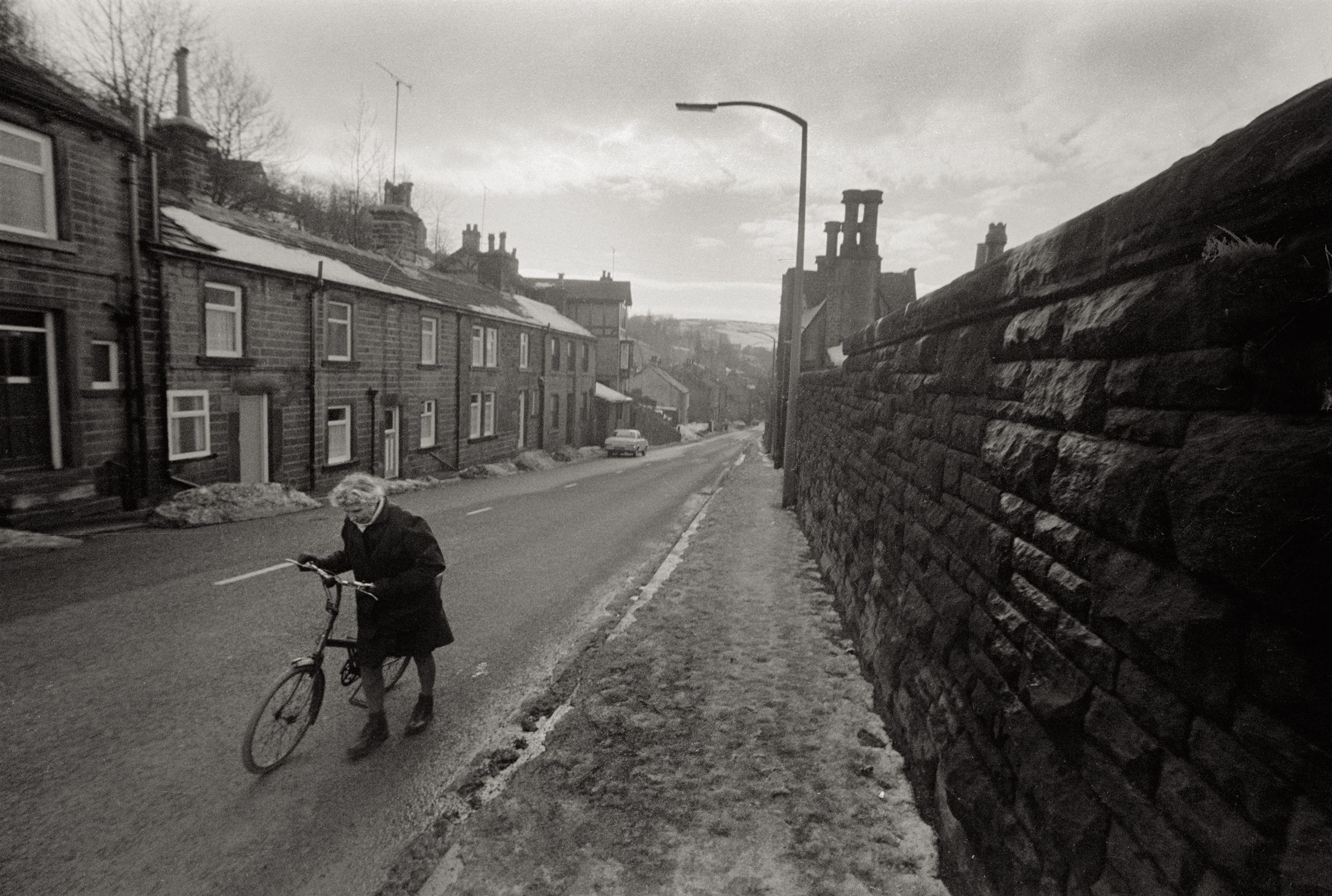
Lady pushing a bike, Holmfirth.
I had recently bought a super wide 18mm lens and it had opened up all sorts of possibilities for compositions. In this shot, I liked how I was able to include the cyclist in the frame, even though she thought I was pointing the camera at something behind her. The increased angle of view gives an apparent change of perspective (viewpoint changes perspective, not lens choice), so the leading lines are exaggerated, pulling you into the centre of the image, but the movement of the woman pulls you out to the left. In the UK, car ownership really expanded when car dealerships started offering finance deals. before then most people used public transport, bikes, or walked. This road is now cluttered with parked cars down the side with the terrace of houses, and is constantly busy with traffic. You would be taking your life in your hands if you pushed a bike up it now.
Age was going to be a factor, I started when I was 19 and I’m now 62 (having grown up somewhere along the way), so my attitude to the world was obviously going to change. When I started I was painfully shy and couldn’t set up a camera in a public place. Even at 22 I would panic if I had to make a phone call, but now I can talk to large crowds about my work without any nerves whatsoever. The book title says 1978 to 1982 because I started to take photography seriously in ’78, though the first four shots in the book were actually taken at the end of 1977. At that time I was just snapping, but these frames stood out from the (mostly terrible) snapping era.
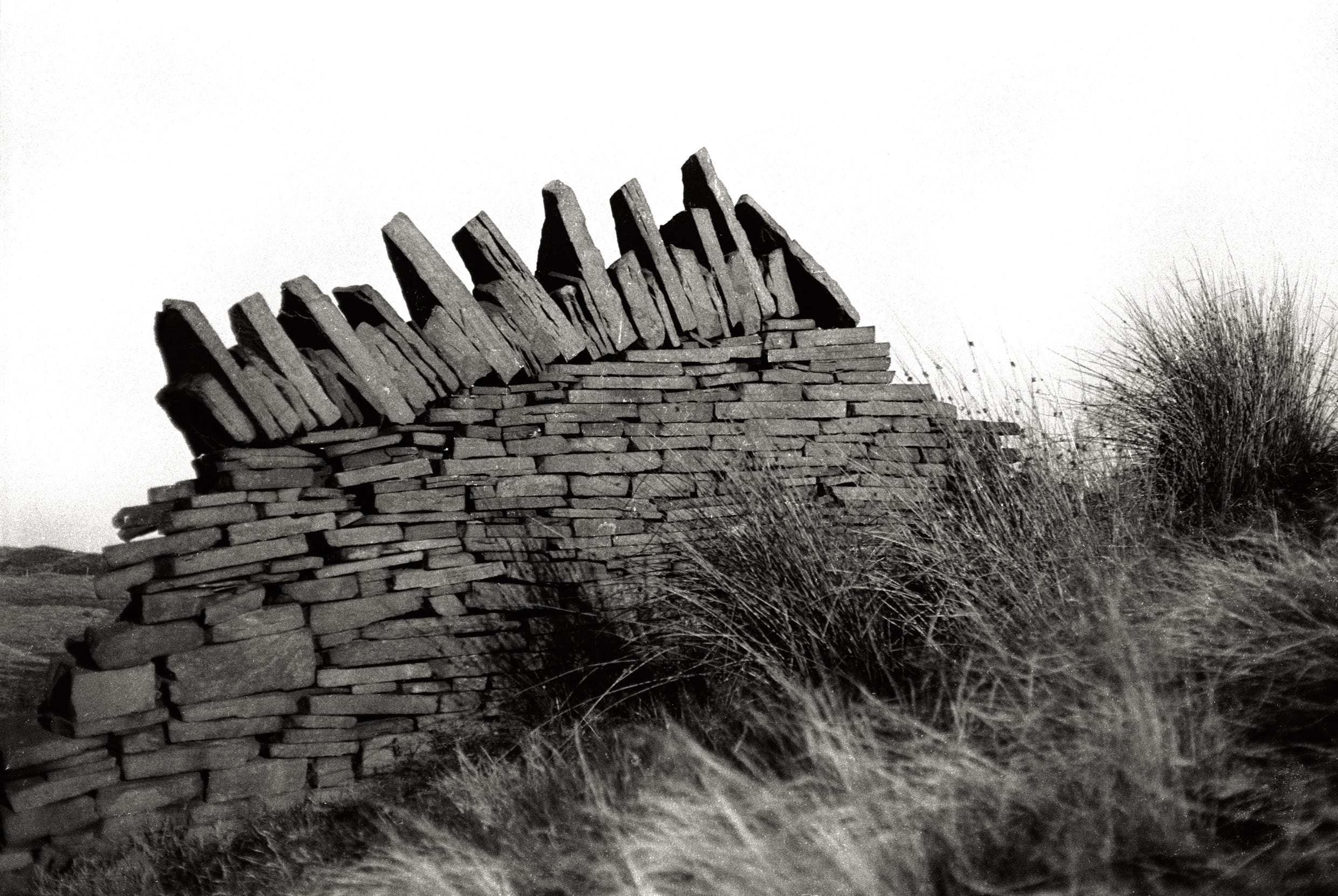
Broken wall, 1977.
In 1976 I was beginning to notice things. I remember very clearly riding on the top deck of a double decker bus as it drove through a wooded area on a sunny autumn day and being totally overwhelmed by the beauty of the light and colour. A year later, this image of the broken wall was taken on the moors up above the small Yorkshire town where I live. At this time, I was just using a camera to photograph me and my friends messing about, but this image shows that I was starting to notice shapes. I wasn’t thinking about the things I was looking at in terms of proportion, tone, contrast, etc, I just looked through the camera, moved it around, and if it felt right I took it. I remember seeing this section of wall as my dad drove us along that road, and asking him if he could stop so I could get a shot of it. The shape made me think of the back of a dinosaur and I scrambled up the hill to get a position where I could show the shapes against the sky.
These walls are all over the moors and there must be thousands of miles of them, they are believed to be up to 600 years old in places. Over the years, sections have been damaged by animals, heavy snowdrifts and people climbing over.
So that was one reason, to see my years of work as a timeline, a progression and as a diary, the other reason was to leave something for my kids. I will be leaving them my prints and my negatives, but they won’t have any idea how to print the negatives, if they had a fire or a flood the work would be lost. With an on-demand book printed version of the images, they could replace anything that was lost or damaged and have less of a storage problem.
Where possible, I have scanned prints to get the images in the book, but many had to be scanned from the original negatives, as I didn’t have many copies of my early prints. Some of the older negatives were quite badly marked with dust and scratches. I tidied them up a little bit, but didn’t want to spend thousands of hours with the spot healing brush (I never use the dust removal tool as it degrades the image too much). I have left these images looking damaged because it was more authentic, I didn’t want to pretend that 42 year old negatives were perfect.
So far it has been fascinating to look into these images, many I had totally forgotten about. With a scanned image, I can zoom in and look around at details that I might have overlooked at the time; Places have changed or gone, people have grown old and pets have died. I was also amazed to see that some shots that I still have in my portfolio were taken in this early period. The night shot on the cover for instance is on the tenth page in my neg file! There is also a montage shot from college which I remember feeling quite proud of at the time, but I now think it looks ridiculous.
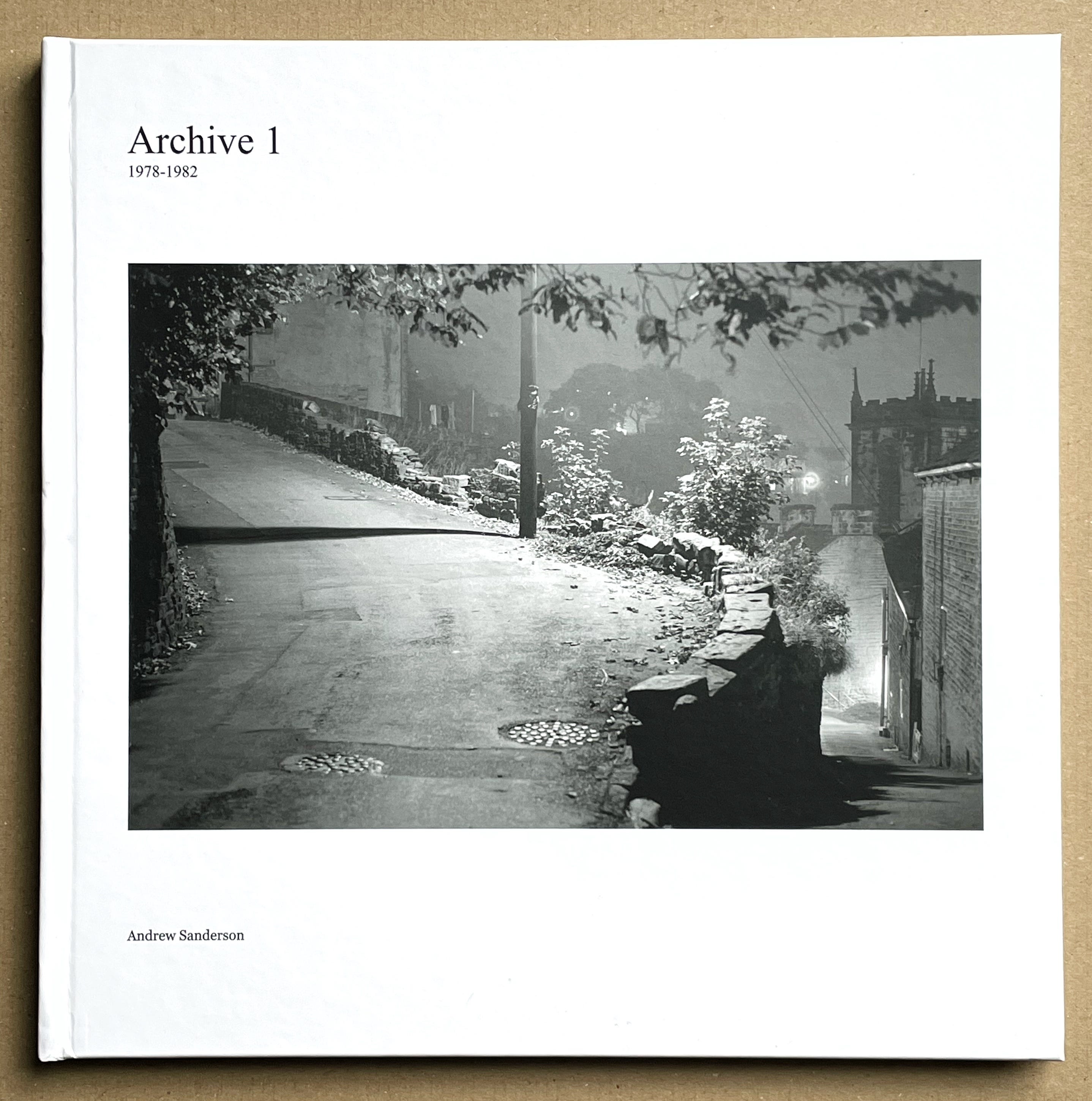
Night scene, back Lane, Holmfirth.
This is probably my earliest success, being on page 10 of my neg file, so that’s pretty early on. If I think about how I got it, I’m amazed that it wasn’t disaster; I didn’t have a proper tripod, so I borrowed a wobbly old wooden one which had been made for a telescope, pushed a screwdriver up through the central hole and lashed it in place with tape, balanced my camera on top and guessed the exposure. When the film was finished, I took it out and realised that I had FP4 in the camera instead of HP5, so all of my other shots were going to be two stops underexposed. I asked my tutor at college how to rectify it and he showed me how to uprate the film, using a semi stand method to stop the contrast getting too high.
The response to this book project has been really encouraging and I will be getting started on book two at some point. One thing I’m really pleased about is that I numbered and filed my negative pages from 1978, this made the job much simpler. When I get to my later work, shot on sheet film in 5x4, 5x7 and 10x8, as well as my paper negative work, I will have a real headache, none of this stuff was dated or numbered and is currently jumbled up in boxes in my studio. Putting these images in date order is going to be tricky, I could just wing it and put them in without worrying, because no one will know but me, but I can’t do that, I have to be true to my original intention to show a timeline and a progression.
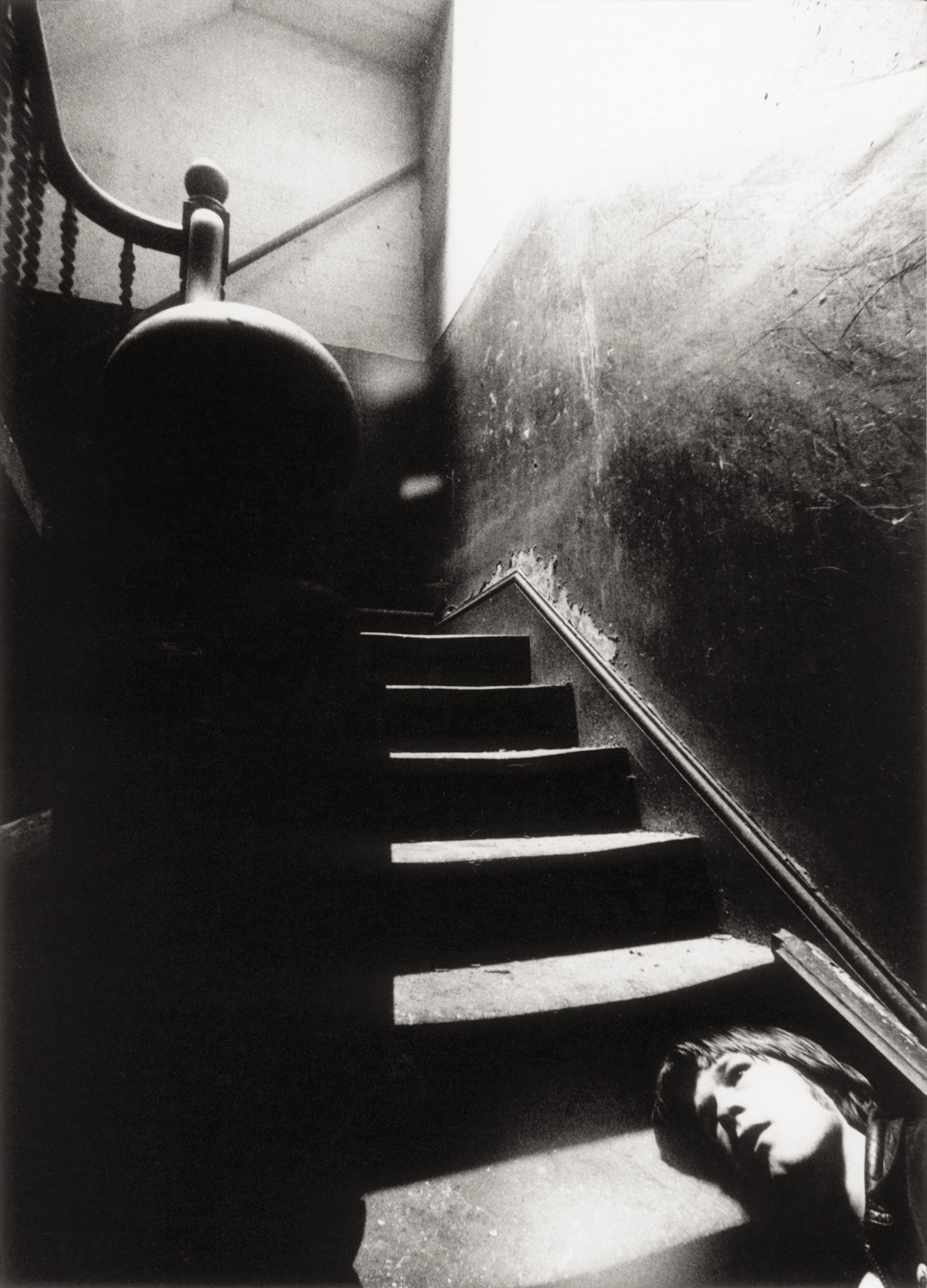
Head on the stairs.
This was taken inside the Congregational church on Hanover Street, Batley, very close to the college I was at. I knew the building had been empty for a long time and students from our College often went inside, but I had never seen it. There was no problem getting in, these sort of buildings never had any kind of security in those days, the door was partly open and it was easy to enter. Knowing that it was going to be dark in there, I took a tripod. I set up this shot to photograph the old staircase, and just at the last minute decided that I would shoot it on self timer and put my head on the bottom step. I still really like it as an image, over forty years later.
I have no idea how many books this project is going to stretch to, or even if I’ll get to the recent stuff, none of us can assume that we will have decades in front of us. I wrote a substack article about the importance of documenting your everyday life on the 24th of Feb, and looking back at my really early stuff has reinforced this. If I could go back and shoot the late 70’s again I would record ordinary life much more, and I would do proper full face portraits of the people of that time. People don’t appear in my pictures till the mmy last year at college, up till then any people in the images are just shots of friends messing around. The headshots appear around 1986, that’s six years after, but at the time it seemed like a far longer period because I was changing so much between the ages of 24 and 28. I had been married, divorced and moved house three times. Another thing that was happening is that I was expanding my camera collection. I used a couple of old Pentax Spotmatics for a long time, with a superwide, a standard and a cheap 80-200 zoom. I had used my fathers Flexaret 6x6, but didn’t get inspired by it, I think I only put three rolls through it. Then I got myself a Mamiya RB67 and a wooden Thornton Pickard quarter plate camera, I progressed up to sheet film after that. Each change in format brought new challenges and new ways of seeing and photographing.
Many of the ways of working that I practice now were begun quite early on; Night photography, Paper negatives, Gum printing, Hand colouring and making crude pinhole cameras out of cardboard, all of these things began in my first four years and I spent the rest of the time trying to get better at them.
As you get older, life goes faster and faster. There are so many things to think about and deal with every day and before you know it, decades have passed. Making this book has allowed me to be self indulgent and experience a bit of time travel. I’ll never again feel like I did then, but I have re-experienced how I saw the world, and that has been magical.
Here is a link to the book; https://www.blurb.com/books/10422285-archive-1-1978-1982
If you find my articles interesting or useful, please spread the word to anyone you can think of who would be interested.
If you have enjoyed this post and the information here and elsewhere on my Substack and you would like to support me, you can subscribe or just buy me a coffee at Ko-fi.com/andrewsandersonphotography You can send as little as £3.00, or more if you are feeling generous. This money goes towards materials used for the tests and printing for these articles. Alternatively you can be a paid subscriber.
Thank you for reading, please let me know your thoughts.
Andrew Sanderson March 2025.
I'm doing similar and was struggling a bit, but realising that someone as accomplished as you are working along the same lines has provided inspiration. Can't pretend my archive is as well organised as yours! Thank you for your posts.
What a beautiful project! The first book is absolutely gorgeous. Can't wait to see the next one.