Reciprocity failure.
Giving a little extra.

A slightly shorter article this week with fewer pictures. I will be on the road shortly and won’t have access to my computer, so I hope you will forgive me.
This week I wanted to write about the subject of Reciprocity Failure. This is something that all film photographers should know about if they intend to shoot any long exposures. The term is often shortened to ‘Reciprocity’ but this is incorrect. Reciprocity is, as the name suggests a reciprocal state, one of mutual dependence, or give and take. In photography it refers to the relationship between shutter speeds and apertures. Each one-stop adjustment of the shutter speed, is equivalent to a one-stop adjustment of the aperture. This holds true throughout the normal use of the camera in most lighting situations. This is a reciprocal arrangement.
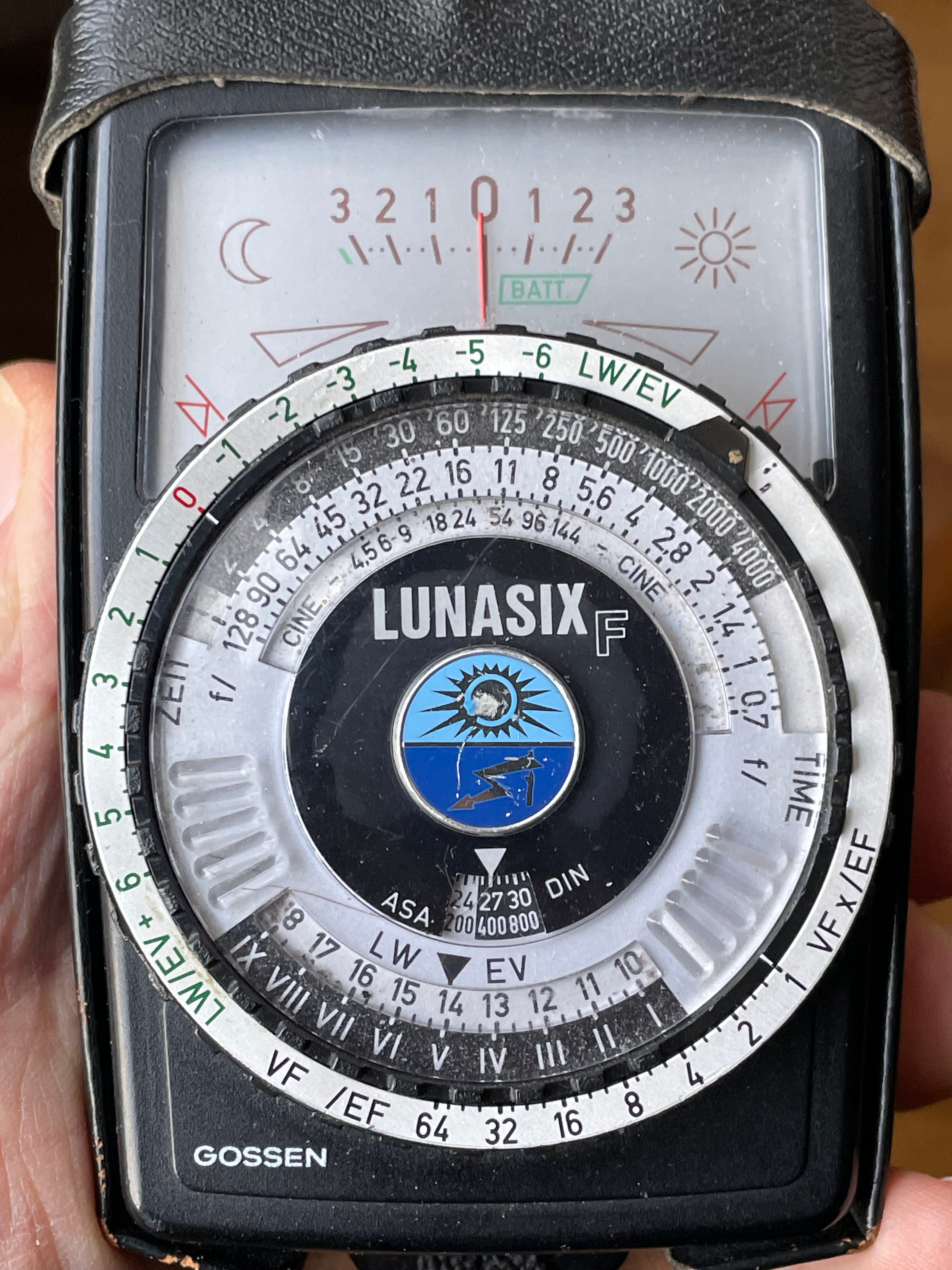
In a given lighting situation you might have an exposure of 125th at f11 (see image above). If you allow one more stop of light in by opening up to f8, then use a shutter speed that reduces exposure by one stop - 250th, then the exposure is the same. If you look at the options on this analogue meter it gives you a number of shutter speed and aperture options that will all give the same exposure, from a 4000th at f2, to a 30th at f22.
This linked relationship begins to slip away with exposures longer than one second, and the longer the indicated exposure, the more of a difference there is between the indicated exposure and what is actually needed. This is why it is referred to as Reciprocity Failure. This is the chart I have used for years:
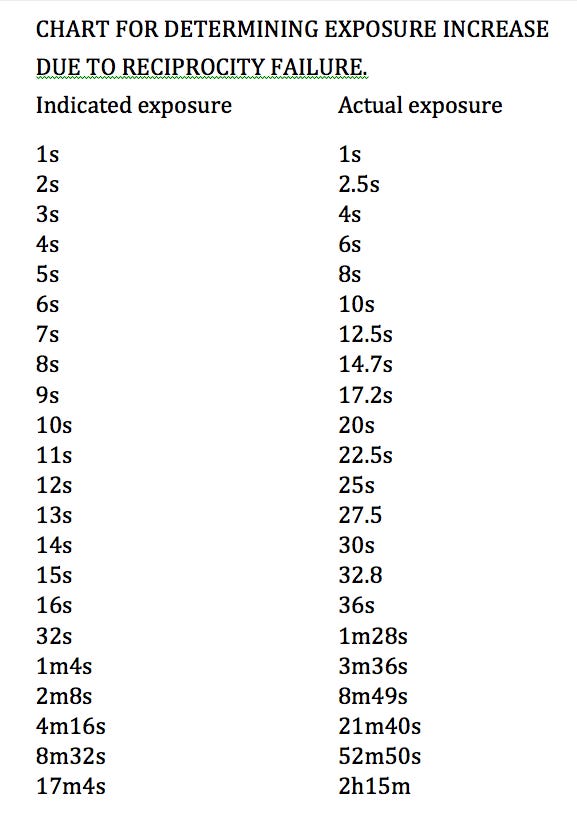
In the lighting situation indicated by the meter above, I wouldn’t need to think about reciprocity failure until I got beyond f128, not a situation that is going to happen with conventional cameras, but if I was using a pinhole camera, the aperture could be three stops smaller than that, requiring an indicated exposure of 8 seconds, but an actual exposure of 15 seconds to record the full image on the film.
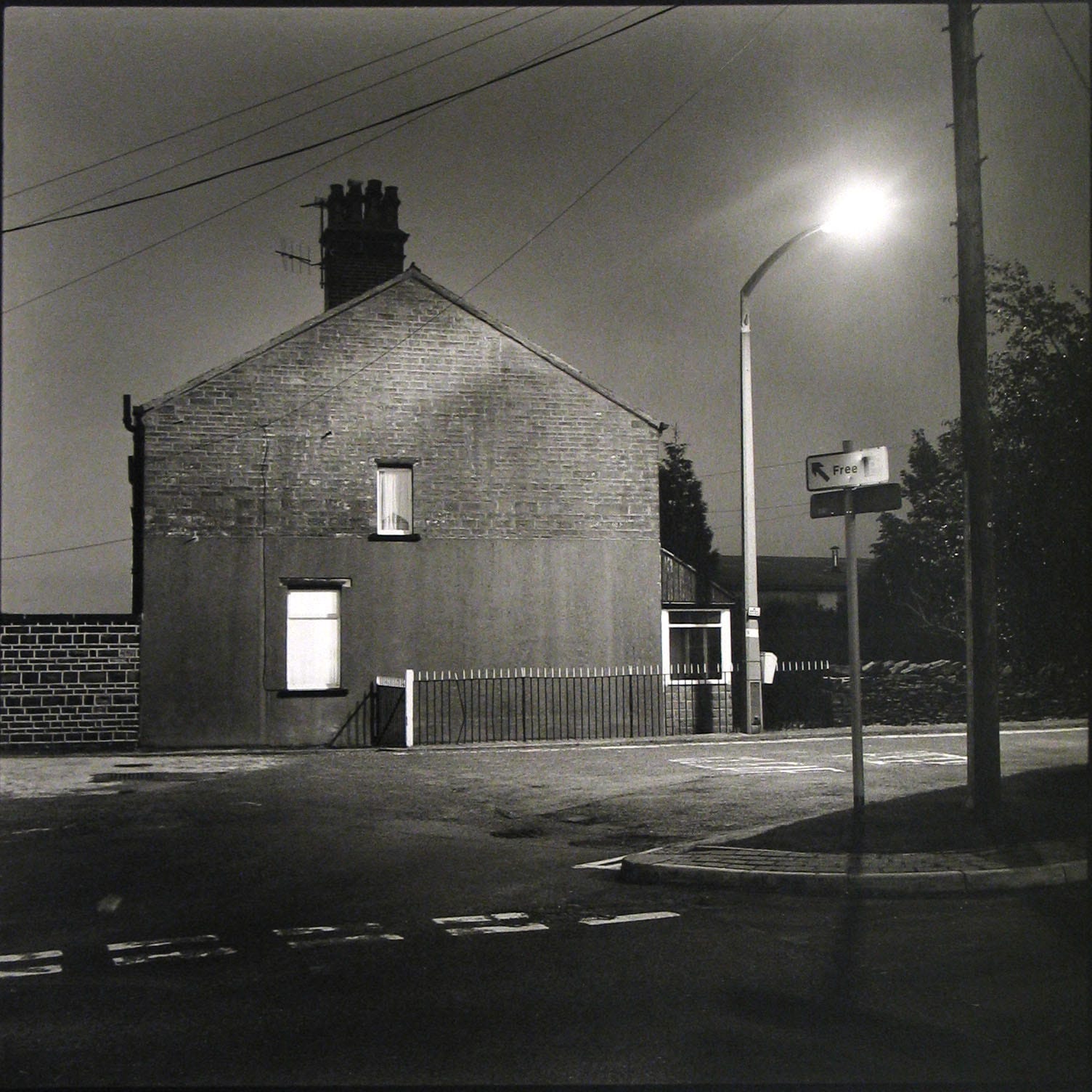
Night photography always involves long exposures, so a reference chart on the back of your meter is a very useful thing.
Film manufacturers (some of them) provide a reference chart or a factor that you multiply your indicated exposure by. I have been using my conversion chart for over 35 years, I copied it out of an old British Journal of Photography magazine. They were kind enough to let me reproduce it in my book on Night Photography, but couldn’t tell me who the original author was. I reproduce it here for your use. I have this on the back of my light meter, though I know the first few off by heart now.
Ilford provide two methods of calculation, one is a list of multiplication factors:
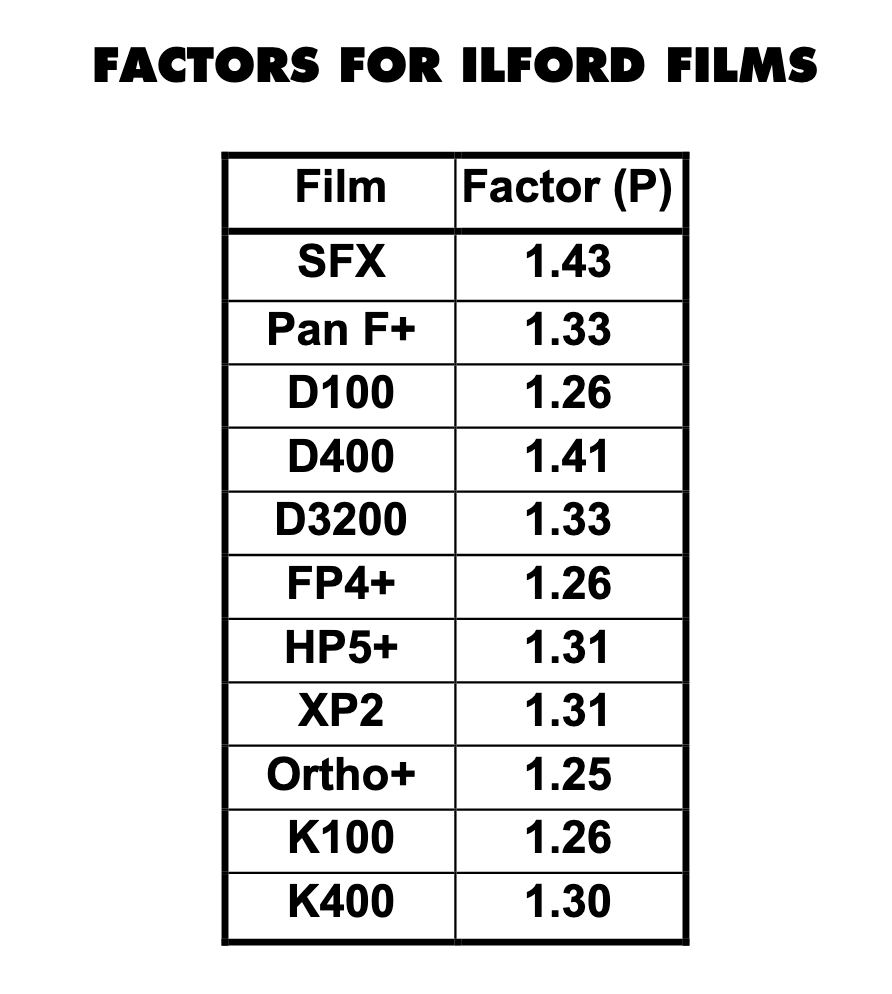
and the other is a chart, which may be more useful out in the field. It is interesting to see that an indicated 8 hour exposure on Delta 400 is 538 hours! Delta 400 is obviously not a good choice for night photography.
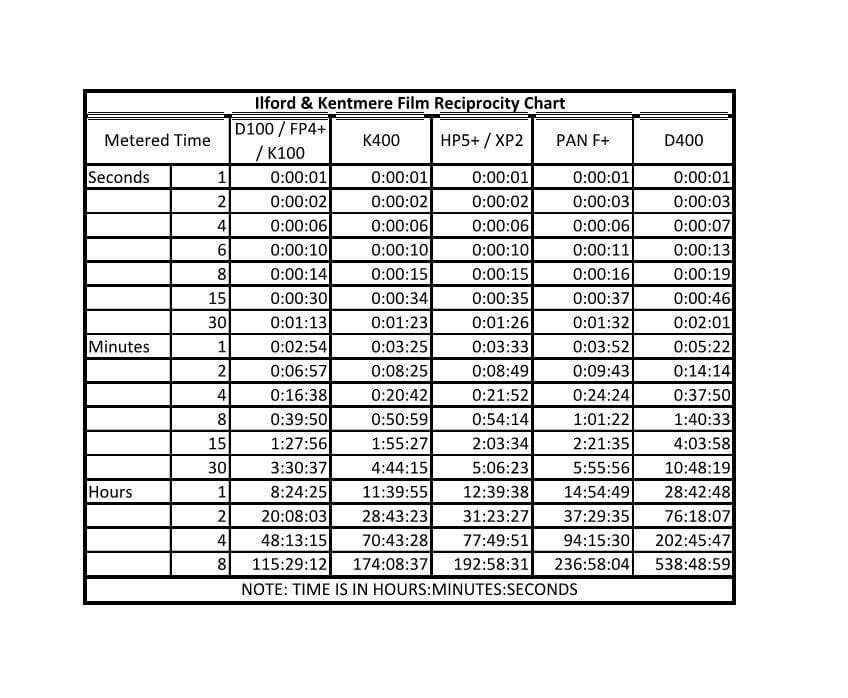
If you have had severe underexposure in the past when doing long exposures, then perhaps this information will help you understand why.
Another situation where long exposures might be encountered is when using very dark neutral density filters to get moving water shots to look like milk. I think you can buy them up to 10 stops in density.
The Ilford information sheet can be downloaded from here: https://www.ilfordphoto.com/wp/wp-content/uploads/2024/05/Reciprocity-Failure-Compensation-v2.pdf
If you find my articles interesting or useful, please spread the word to anyone you can think of who would be interested.
If you have enjoyed this post and the information here and elsewhere on my Substack and you would like to support me, you can subscribe or just buy me a coffee at Ko-fi.com/andrewsandersonphotography You can send as little as £5.00, or more if you are feeling generous. This money goes towards materials used for the tests and printing for these articles. Alternatively you can be a paid subscriber.
Thank you for reading, please let me know your thoughts.
Andrew Sanderson March 2026.
Other places to see my work;
Instagram; http://instagram.com/andrewsandersonphotography
Facebook; https://www.facebook.com/andrew.sanderson.96155/
Original hand made darkroom prints are available from my online shop; www.andrewsandersonphotography.bigcartel.com
I also offer one to one workshops at my darkroom/studio in West Yorkshire, UK. If you are interested please email me at andrewsandersonphoto@gmail.com
Interesting article, Andrew, thanks for sharing the knowledge!
I use two apps on my phone when I do long exposures: L(ong)E(exposure) Calculator - straightforward, gives you the exposure times when using various filters, and the more complex Art of Foto app - this one, among other awesome stuff, allows calculations based on specific emulsions on their own or in combination with various filters. Great little tools, always in my pocket.
Difficult subjects with great titles: reciprocity failure(s).